Some time ago, I started asking myself a question every time I walk through a city.
It has nothing to do with its buildings.
Or how much the square meter costs.
Not even how many restaurants, malls, or real estate projects it has.
It's much simpler than that:
What do I do once I finish whatever I came here to do?
Let's imagine for a moment that we go out for lunch.
We get to the restaurant. We eat. We talk. We pay the bill.
And we leave.
In some cities, that's where another part of the day begins.
We walk.
We find a plaza.
We stop in front of a shop.
We grab a coffee.
We discover a street we didn't know.
We sit down.
We keep walking.
The city starts offering us small reasons to stay.
But in other cities, the exact opposite happens.
We leave the restaurant.
We find the car.
We get in.
And we go.
We ate in the city, but we barely experienced it.
And I think that difference should worry us far more than it seems to.
Because a city can be full of people and still have streets with no life in them.
We can build excellent restaurants.
Large shopping malls.
Modern office buildings.
Residential towers.
Hotels.
Supermarkets.
Even new transit stations.
And still fail at something much more basic:
Getting people to want to stay outside.
Because a city doesn't come alive just by having people in it.
It comes alive when those people find reasons to walk, meet, stop, shop, talk, watch, or simply stay.
And this is where I start to question some of the decisions we've made over the years.
Are we designing places to live, or destinations we simply arrive at and then leave?
Let's take the trip together.
Let's imagine we're in Madrid, Barcelona, Copenhagen, Buenos Aires, or any of the many places where walking is part of the urban experience.
We finish lunch.
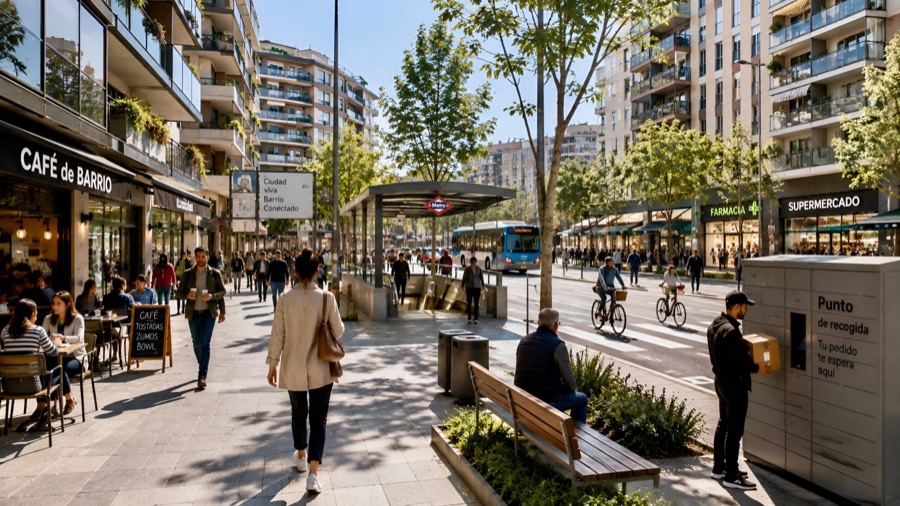
What do we have around us?
Probably shops.
Housing.
Cafés.
Services.
Trees.
Plazas.
Public transit.
People walking.
Benches.
Terraces.
Different activities happening at once.
We don't necessarily need to decide what to do next.
The city itself starts suggesting it to us.
Now let's change the scene.
We're in Lima.
We leave an excellent restaurant.
What do we find?
In too many places, an avenue that's hard to cross.
Walls.
Fences.
Parking lots.
Narrow or broken sidewalks.
Little shade.
Distances that invite you to get in the car rather than keep walking.
And so we do what the city is practically asking us to do:
We leave.
That behavior, which we often attribute solely to people, may also be a consequence of the place we built for them.
Maybe the problem isn't that people don't want to walk.
Maybe we should ask ourselves:
what have we given them that would make them want to?
For decades we've thought of the city as a sum of individual projects.
The developer looks at their lot.
The retailer looks at their store.
The restaurant looks at its premises.
The logistics operator looks at its distribution.
The municipality looks at the road.
Transit looks at how to move passengers.
Housing looks at how to house residents.
Each one may be making a perfectly reasonable decision within its own boundaries.
But the person lives outside those boundaries.
Steps out of the building.
Crosses the street.
Walks to a store.
Looks for transit.
Goes to work.
Picks up the kids.
Shops.
Eats.
Goes back home.
For that person, our divisions between real estate, retail, mobility, logistics, housing, and public space don't exist.
Only one thing exists: the city.
And maybe that's one of our biggest mistakes.
We've worried enormously about getting people to arrive.
But much less about getting them to want to stay.
We build parking lots so they can arrive.
Roads so they can arrive.
Access points so they can arrive.
Malls so they can arrive.
Restaurants so they can arrive.
Real estate projects so they can arrive.
But what have we built between all those destinations?
Because it's precisely between one destination and the next that the city actually happens.
The sidewalk.
The corner.
The crossing.
The plaza.
A building's ground floor.
The shade of a tree.
The neighborhood shop.
The station.
The bench where someone decides to stay ten minutes longer.
Those seemingly secondary spaces can end up determining something extraordinarily important:
Whether a person stays or leaves.
And staying also has economic value.
This isn't just a conversation about quality of life.
It should also matter to those of us who develop, invest, operate retail businesses, or decide where to put capital.
A person who stays walks.
A person who walks discovers.
A person who discovers might step into a store, sit down at a café, use a service, or come across some other activity that wasn't originally part of their trip.
The city starts generating interactions that no single, isolated project could produce on its own.
That's why we should perhaps add a different question when evaluating a location:
How long does a person want to stay here after finishing what they came to do?
I've never seen that variable highlighted in a real estate listing.
But I'm increasingly convinced we should be tracking it.
Because we can keep building square meters without building a city.
We can have extraordinary buildings surrounded by streets nobody wants to walk.
Packed restaurants surrounded by empty sidewalks.
Malls with thousands of visitors while urban life practically disappears outside.
Housing where people live but need to travel for practically everything.
And then we'll end up with plenty of successful destinations connected by spaces we simply want to get through as fast as possible.
A city where we arrive, consume, and leave.
Maybe that's why, coming back from certain cities, I often remember their streets as much as their buildings.
I remember walking.
Stopping.
Discovering something I wasn't looking for.
Changing my route simply because a street looked interesting.
That's also a city.
And it hardly ever shows up in a rendering.
I believe those of us who play some role in building our cities — developers, architects, retailers, investors, operators, authorities, and those of us who plan infrastructure — should start asking ourselves a question before our next decision:
Are we building something that will only get people to arrive, or are we helping build a place where they'll also want to stay?
Because maybe a city's true success doesn't lie only in how many people it manages to attract.
But in something much harder:
How many of them, once they have no obligation left to stay, decide to stick around a little longer.