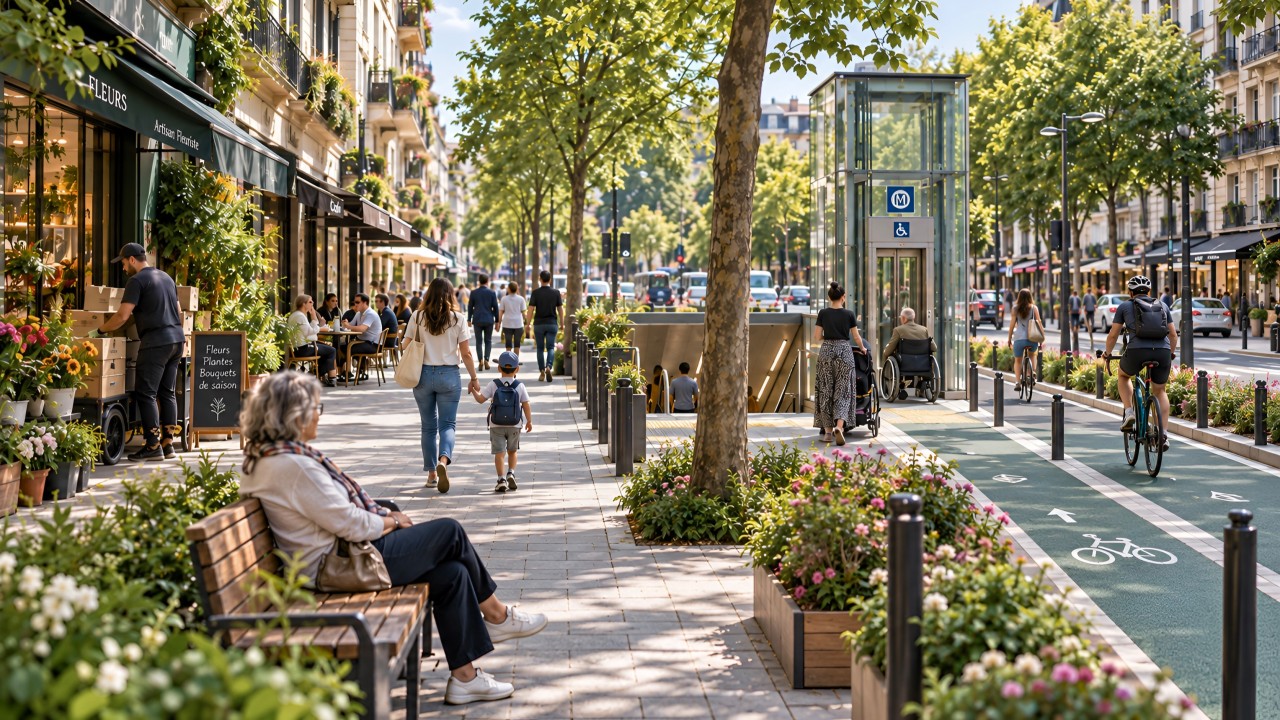
We can invest millions in a mixed-use project and end up building several worlds that never meet.
One entrance for living, another for working, another for shopping and another for parking.
Everything works.
Everything is properly solved.
But almost nothing is connected.
And that is where a question appears that interests me more and more:
At what point does a building stop being just a building and truly begin to become a city?
For a long time we have evaluated projects by looking inward: square meters, units, retail, profitability, buildable capacity.
All of that matters.
But I am increasingly interested in something else:
What exactly happens at the point where the project touches the city.
Because that is often where it is defined whether we are building a piece of the city or simply an isolated object.
Mixing uses is not enough
We can bring housing, offices, retail and services together on the same plot.
But the city begins to appear when those activities begin to meet.
When the person who lives there shops downstairs.
When the person who works there has lunch nearby.
When someone who neither lives nor works in the project has a reason to enter, cross through or stay.
When the ground floor stops being just the first floor of the building and starts behaving like a continuation of the street.
That is why lately I try to look at projects from another place:
From the sidewalk across the street.
Not from the rendering.
Not from the buildable area.
Not from the floor plan.
From the outside.
And from there I begin to ask myself three questions:
- Why would someone come? To live, work, shop, eat, meet or simply pass through.
- Why would they stay? Measuring how many people cross a place is one thing; observing how many decide to remain is quite another.
- What are we giving back to the city? A better sidewalk, shade, retail, routes, places to sit, clearer connections and a logistics operation that works without invading people’s space.
That last question seems more and more important to me.
Because for years we have grown used to thinking about how much value a project can extract from a location.
Perhaps we should also ask how much value it can give back.
And here something appears that we often forget.
Users do not experience architecture on one side, urbanism on another, retail on another, mobility on another and logistics on another.
They experience everything at the same time.
That is why there is an idea that I find harder and harder to ignore:
Mixing uses occupies square meters. Mixing lives begins to create a city.
And perhaps that is the simplest lesson I take from all this:
before asking how much we can build within a lot, it is worth looking at three things:
Why a person would come, what would make them stay and what the city receives in return.
Because perhaps a building truly begins to become a city when it stops thinking only about what it contains...
and also starts thinking about what it connects.
What do you think a project should give back to the city, besides square meters?