For decades, metro stations have been conceived purely as places to pass through.
Spaces designed to move people from one point in the city to another.
But in many cities around the world, something interesting is starting to happen.
Stations are beginning to turn into multifunctional urban infrastructure, where mobility, retail, services, and logistics converge — and where new forms of economic activity, housing, and urban life are starting to take shape as well.
What used to be simply a transit node is starting to become a new centrality within the city.
A piece of news recently caught my attention.
Metro de Madrid has taken another step in its urban logistics strategy, announcing — together with GLS Spain — the installation of smart lockers across all 19 stations of Line 3.
At first glance, this might look like a simple expansion of parcel pickup points.
But look at the model more closely, and what we're actually seeing is a new way of understanding the urban distribution of goods.
A model that is far more efficient, more sustainable, and much better aligned with the kind of cities we want to build.
When the Movement of People and the Movement of Goods Start to Connect
For decades, cities have planned two completely separate systems.
On one side, the movement of people: metro, buses, trains, trams.
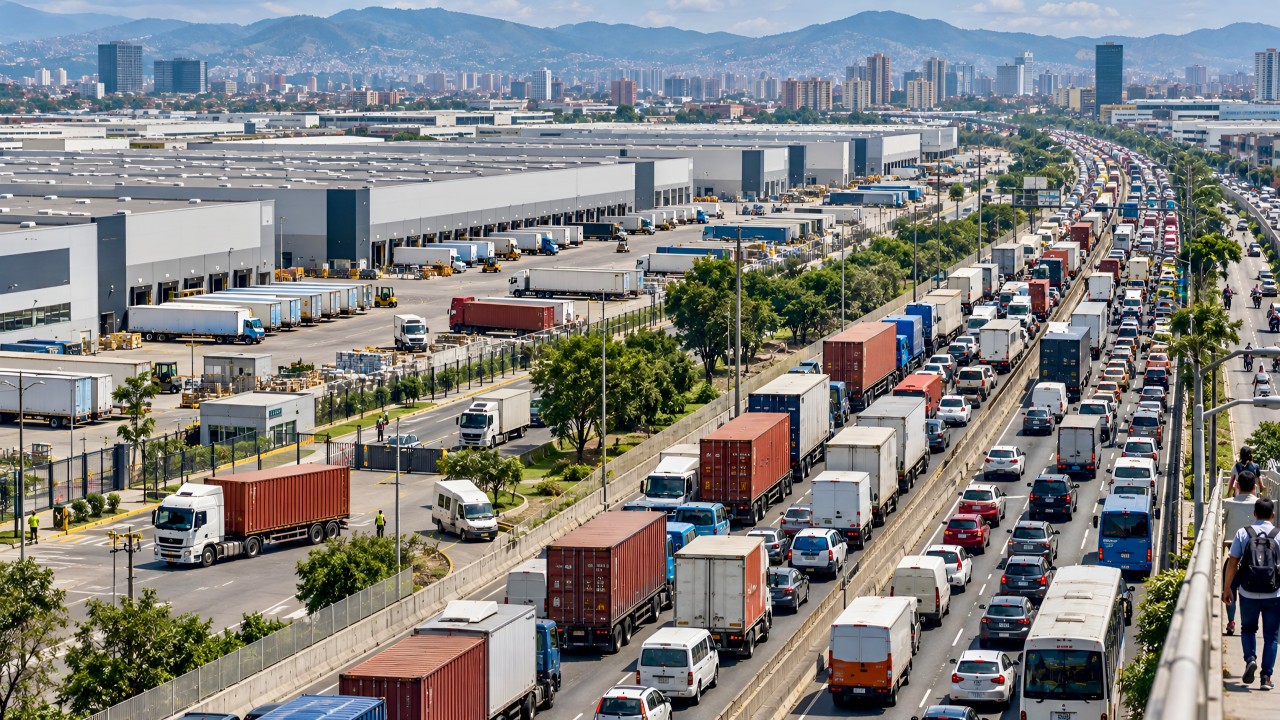
On the other, the movement of goods: trucks, vans, and motorbikes crowding the streets.
The result is plain to see in many Latin American cities:
congested traffic
thousands of delivery vehicles circulating at the same time
failed deliveries
high logistics costs
polluting emissions
What the model taking shape in Madrid proposes is something different.
Using urban infrastructure that already exists to build a far smarter logistics network.
The mechanics are simple but powerful:
Goods are consolidated at urban logistics hubs.
They're transported using rail infrastructure.
They're distributed out to metro stations.
Users pick up their packages from smart lockers as part of their daily commute.
In this way, the package's journey gets folded into the citizen's journey.
A Model That Cuts Traffic, Costs, and Emissions
This kind of solution has a direct impact on several urban problems.
First, it reduces the number of delivery vehicles circulating through the city.
When part of the deliveries happen through lockers, the need to drop off packages door by door drops sharply.
Second, it improves logistics efficiency.
A single delivery point can consolidate hundreds of packages that users then collect on their own flexible schedule.
Third, it reduces polluting emissions.
Rail transport is electric, high-capacity, and far more energy-efficient than road transport.
And fourth, it improves the customer experience, letting people pick up their package whenever suits them, without depending on delivery windows.
Could a Model Like This Work in Latin America?
The answer is yes.
But not necessarily in the same form.
Every city has different realities.
Santiago de Chile: an immediate opportunity
Metro de Santiago is probably the best-positioned network in South America for this kind of initiative.
With over a hundred stations and extensive coverage, the metro could easily become the backbone of an urban logistics network built on lockers and microhubs.
The busiest stations could integrate:
smart lockers
parcel consolidation points
small urban distribution centers
This would allow part of e-commerce deliveries to happen outside the home, significantly easing the pressure on urban traffic.
Lima: a possible hybrid model
In Lima's case, the situation is different.
The city has a single fully operational elevated line and a second underground line still under construction.
Even so, with this limited infrastructure, interesting solutions could already be implemented.
The most important stations could become:
parcel pickup points
urban microhubs
logistics nodes connected to local commerce
This would allow Lima to start building a more efficient distribution network without waiting for the whole metro network to be finished.
Cities without a metro can adapt this too
Even in cities without urban rail systems, the concept still holds.
Lockers and microhubs can be integrated into:
BRT stations
bus terminals
shopping centers
supermarkets
gas stations
What matters isn't the metro itself.
What matters is taking advantage of urban nodes that people already pass through every day.
The Logistics of the Future Will Be Multimodal
Urban goods distribution is entering a new stage.
A stage where:
public transport
urban microhubs
smart lockers
pickup points
are starting to merge into a single system.
This doesn't just improve logistics efficiency.
It also helps build cities with less traffic, fewer emissions, and more space for people.
The Question We Need to Ask Ourselves
If metro stations are starting to become logistics nodes in cities like Madrid…
Are we, in Latin America, thinking about how to integrate logistics into our existing urban infrastructure?
Or will we keep designing systems where thousands of delivery vehicles compete every day for the same space on increasingly congested streets?
Because maybe the next revolution in last-mile delivery won't come from more trucks or more motorbikes.
Maybe it will come from underground, from the metro stations that millions of people use every single day.