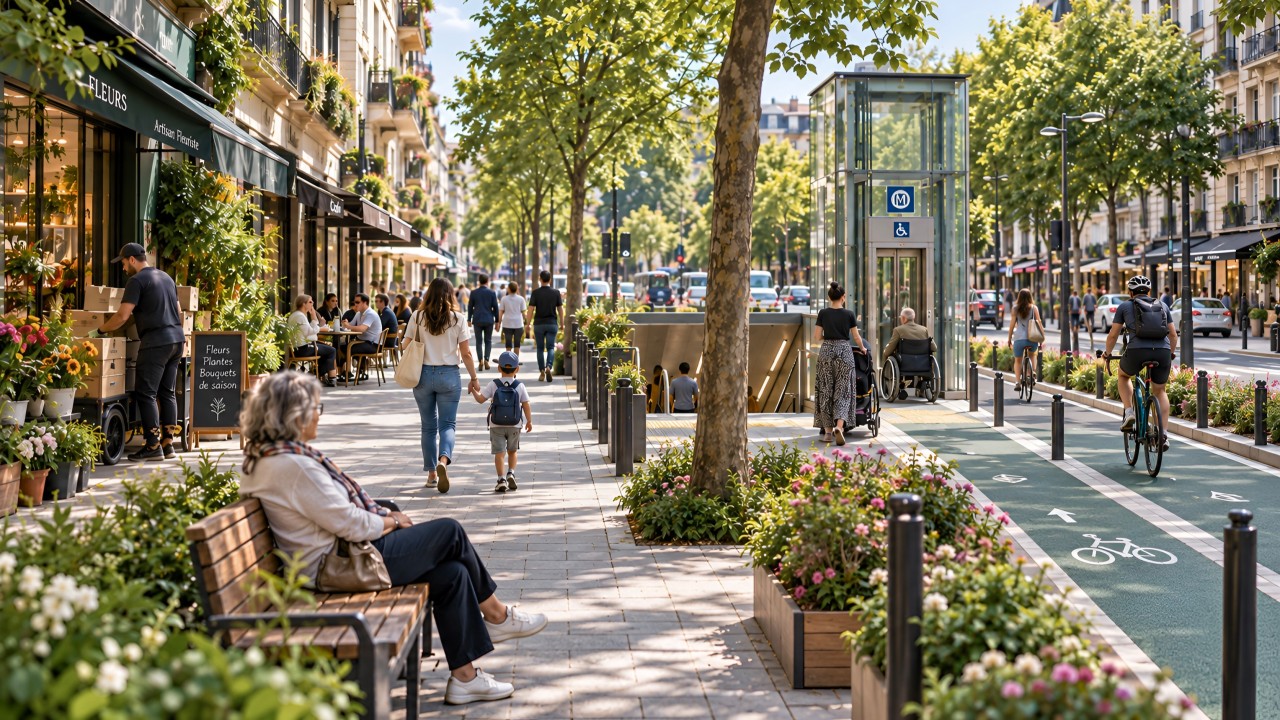
On one of my trips to Madrid I left the hotel early because I had a meeting a few hours later.
And as I usually do when I'm in another city, I chose to walk.
Not because I had to.
Because I like to understand a city from the street.
It was a little after seven in the morning. The air was still cool and Madrid was just beginning to stir.
If you had been walking with me, you would probably have seen the same thing.
Cafés raising their shutters. Parents hurrying along with their children. People heading into the metro. Workers arriving at offices. Vehicles finishing deliveries before the streets began to fill up.
I hadn't gone out to study anything.
I was simply walking.
But I began to notice something we normally take for granted:
who was actually using that street at that hour.
Hours later I passed through the same area again.
And it seemed like a different place.
The cafés were full. There were people having lunch, meeting, shopping, running errands. The terraces were occupied and people walked at a different pace.
Later I came back once more.
And it had changed again.
That was when I thought of something I now try to remember every time I evaluate an area:
I had walked practically the same street three times, but I had come to know three different cities.
“A lot of people pass through here”
You have surely heard that phrase too.
I have heard it countless times when a store, a plot of land or a new location is being analyzed.
And it always strikes me as incomplete.
Because other questions immediately arise:
- Who is passing by?
- At what time?
- Where are they going?
- Do they have time to stop?
- Do they live there, work there, or simply cut through the area?
- Does that movement last all day or disappear a few hours later?
A person can have exactly the same spending power and behave in a completely different way depending on the moment.
First thing in the morning they may just want to get to work on time.
At midday they may have forty minutes for lunch.
In the afternoon they might take care of a purchase.
In the evening they may want to stroll, have dinner or linger in conversation.
The person is still the same.
What changed was the context.
And with it, the value of that corner can change too.
That is where retail starts to look different
Those of us who have been involved in commerce know how much a good location can weigh.
But I increasingly think that a location should not be understood merely as a point on the map.
The same corner can have several values over the course of a single day.
Not necessarily because the number of people changes.
But because what those people need and are willing to do at that moment changes.
Counting traffic helps.
Understanding behavior helps much more.
In logistics I have seen it from another angle
That morning there was something that a few hours later had practically disappeared: the restocking.
The same meters of street that would later be occupied by pedestrians, customers and terraces were being used to bring products in.
That felt especially familiar to me.
Because the city doesn't only receive people.
It also needs to receive goods.
And when we don't think about when that supply should happen, conflict appears.
Double parking. Loading on the sidewalk. Delivery drivers looking for any available space.
For years we have talked a great deal about where urban logistics should operate.
I increasingly think we must also ask ourselves when.
Because not everything needs to use the same space at the same time.
And then another way of looking at an investment appears
When you or I evaluate a project, we surely look at location, connectivity, density, demand, prices and potential.
So do I.
But after experiences like that one I try to add another question:
how many hours a day does this area really work?
There are places that depend almost exclusively on offices.
Others live around students.
Some residential neighborhoods seem quiet during the day and change completely when their residents return.
And there are areas where different activities take over from one another.
Workers in the morning.
Commerce at midday.
Residents in the afternoon.
Restaurants and meeting places at night.
I don't believe a good city has to be active twenty-four hours a day.
What interests me is something simpler:
that the infrastructure we have already built can have more than one life during the same day.
Since then I try to go back
When an area interests me, I try not to see it just once.
I walk it early.
I return during the day.
And, if I can, I come back when evening falls.
I recommend you try it.
Often the initial impression changes completely.
Because a city is not just a plan, a photograph or a spreadsheet.
It is also schedules.
Routines.
Waits.
Encounters.
Movements.
People doing different things in the same space throughout the day.
And perhaps the next time you are evaluating a plot of land, a store, an investment or simply an area you don't know, it may be worth doing something very simple:
going back a few hours later.
The street may still be in exactly the same place.
But you will probably discover another city.
Have you also returned to the same area at a different hour and felt you were in a completely different place?