In urban logistics, there's infrastructure you don't always see, but that turns out to be essential for everything to work. One of them is what in Spanish is called an almacén pulmón — literally a "lung warehouse," or buffer warehouse: a temporary, flexible, strategic space that lets the operation breathe when the pace of the city, or of demand, picks up.
Sometimes efficiency doesn't come from having more trucks or more square meters, but from knowing where to balance flows. That's where buffer warehouses make the difference: they're the equilibrium point between capacity, demand, and sustainability.
When the city needs to catch its breath
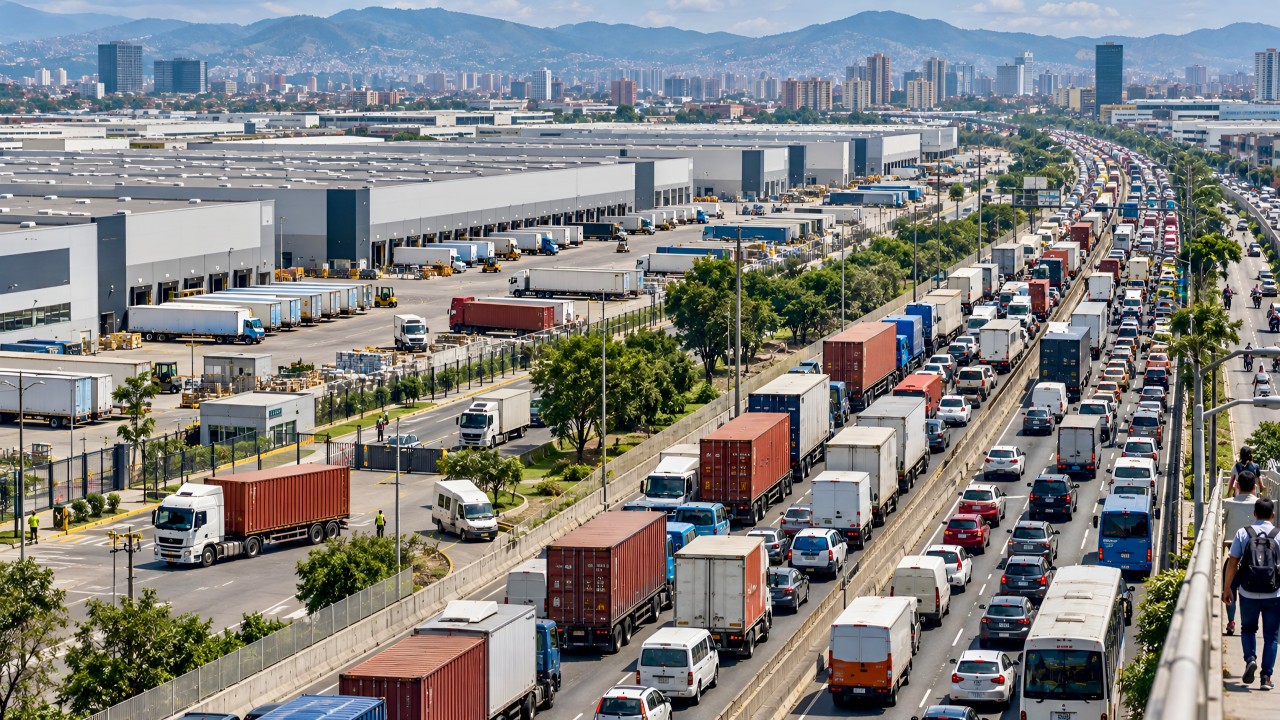
In many Latin American cities, logistics has developed toward the periphery. Large distribution centers sit far from where consumption happens, forcing trucks to cover long distances and clogging the main urban arteries. The result is predictable: more traffic, more emissions, higher operating costs.
Against that backdrop, the urban buffer warehouse emerges as a smart response. Located within or near urban areas, these spaces absorb demand spikes, synchronize deliveries, and cut out unnecessary trips. Their goal isn't to store more — it's to keep the flow steady when the city, or the operation, hits a point of saturation.
The real value of a buffer warehouse isn't in the space it occupies, but in the fluidity it generates across the whole supply chain.
How they work, and why they're different
An urban buffer warehouse doesn't replace large logistics centers: it complements them. Its job is to act as a shock absorber between the large inbound flow arriving from the periphery and the fine-grained distribution within the city.
Their value lies in being designed to generate efficiency without requiring large footprints, but rather to ensure operational continuity. Generally, they:
Sit in strategic locations, close to major avenues, metro stations, or commercial areas, putting them closer to points of consumption.
Receive goods from larger logistics centers and redistribute them to microhubs, stores, or final delivery points.
Operate at a small scale, between 300 and 2,000 m², but with significant operational impact.
Enable fast transshipment, load consolidation, or cross-docking, cutting wait times and unnecessary trips.
Run on electric or light-duty vehicles, lowering the environmental footprint and improving urban mobility.
In short, they're the invisible link that keeps the city supplied without overwhelming it.
Why they're essential to modern logistics
In an increasingly demanding environment, urban buffer warehouses have become a key piece of modern logistics. Their value lies in their ability to keep the system running when the main processes hit their limits.
Among their main benefits:
They decongest the core system by lightening the load on large logistics centers and ports.
They boost operational efficiency by cutting wait times and optimizing delivery scheduling.
They improve the customer experience by enabling faster, more precise deliveries.
They promote sustainability by consolidating routes, cutting emissions, and favoring cleaner transport.
They strengthen resilience by providing room to maneuver during disruptions or seasonal peaks.
Each of these benefits responds to a present-day need: building a logistics model that combines speed with sustainability, without upsetting the urban balance.
The new link in the urban network
Globally, cities are rethinking their logistics model toward more decentralized, proximity-based systems. In this new scheme, urban buffer warehouses function as decongestion micro-centers, embedded within a broader network that connects different operational levels:
Logistics centers: manage the large flow of goods entering the city.
Urban buffers: act as points of equilibrium and temporary storage.
Microhubs: handle last-mile consolidation and delivery prep.
Delivery points: bring the final product closer to the consumer or local store.
Examples of this shift can already be seen in Paris, Madrid, or Barcelona, where old parking lots, building ground floors, or underused warehouses have been converted into small urban logistics centers. These spaces reduce heavy traffic, improve delivery efficiency, and bring fluidity back to the urban environment.
In cities like Lima, areas along the Evitamiento corridor, Santa Anita, or Metro Line 2 could play that same role: serving as strategic nodes that balance the flow of goods and bring logistics closer to the city, without overwhelming it.
Final thought
In every supply chain, there's something more valuable than speed: continuity.
Modern logistics is no longer defined by speed alone, but by its ability to adapt and stay in balance. A system with no buffer space is a system living on the edge. That's why urban buffer warehouses have become essential: they let you prevent instead of react, optimize instead of expand, and keep the supply chain alive even under the greatest pressure.
At a time when the city and its logistics share the same space, these small warehouses represent something much bigger: the possibility of a logistics model that is more human, more efficient, and more sustainable.
Because in the end, cities — like people — also need to breathe in order to function.