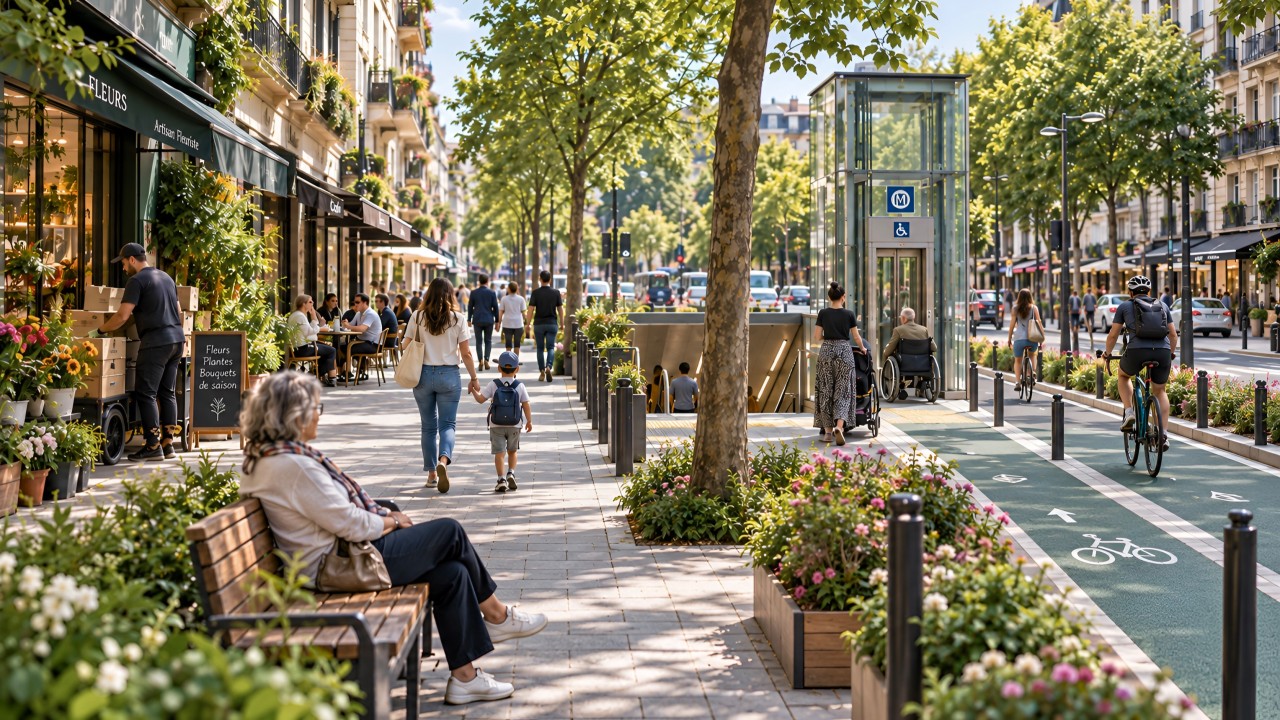
On one of my trips to Paris I ended up walking near the Seine.
I had several places I wanted to see that day and my plan was to keep moving.
But at one point I sat down.
Just for a few minutes.
Or so I thought.
Quite a while later I was still there.
And there came a moment when I stopped looking at the river, the bridges and the buildings.
I started looking at the people.
Some were talking.
Others were reading.
There were those eating something, those simply watching the river go by, and people who seemed to have made that place part of their routine.
Nobody was obliged to stay.
But many did.
And then a question arose that I have tried to ask myself ever since whenever I get to know a new place:
what is it about a space that makes us want to remain?
When I arrive somewhere new, I no longer look only at those who walk
For many years, when I observed an area, my attention naturally went to movement.
- How many people passed by.
- Where they came from.
- Where they were going.
- What commerce was around.
- How well connected it was.
All of that is still important.
But that day I began paying attention to something different:
to those who were not moving.
- Where they sat.
- Which spaces were left empty.
- Where small groups appeared.
- Which routes were walked slowly.
- Where someone stopped without needing to.
Because perhaps the people who remain are also telling a story about that place.
Arriving does not mean wanting to stay
It has surely happened to you too.
You arrive at an architecturally spectacular space.
- You walk through it.
- You look at a few details.
- Maybe you take a photograph.
- And a few minutes later you keep walking.
There isn't necessarily anything wrong with that place.
You simply didn't find many reasons to remain.
And then exactly the opposite happens.
You arrive at a much simpler spot.
- You sit down.
- You look around.
- A coffee appears.
- Someone arrives.
- There is shade.
- Activity.
- People.
And when you check the time again, far more of it has passed than you imagined.
The difference is not always in the size.
Nor in how much it cost to build.
Not even in how spectacular its architecture is.
Sometimes it lies in something much harder to measure:
how being there makes you feel.
That is where retail starts to look different
As I watched those people by the Seine, something occurred to me.
Many of the places that work best don't necessarily start by asking you to consume.
First they achieve something harder:
that you want to be there.
And only afterwards do the café, the restaurant, the shop or any other activity appear.
That doesn't mean every person who stays is going to buy.
That would be too simplistic.
What is interesting is that staying creates possibilities.
- Time to observe.
- To discover something.
- To run into someone.
- To sit down.
- To come back.
To make that place part of your routine.
And for retail, that relationship with the space can be as important as the traffic passing in front of a door.
For those of us who develop, another question arises
When I see a plaza, a ground floor or a common space, I am less and less interested in knowing only how many people can cross it.
I also want to know:
why would someone decide to stay there?
Because we can design extraordinarily efficient circulation.
Move people quickly.
Connect entrances.
Optimize routes.
And still create places where nobody remains longer than necessary.
A plaza can look extraordinary in a render and remain empty.
A lobby can have spectacular materials and not invite anyone to stay.
And an apparently simple space can end up full of people talking, working, resting or simply watching the city go by.
That is where value starts to look different.
Over time I have started to observe other things
Since that day, when I arrive at a plaza or a new project, before looking only at how many people are walking I try to identify something much simpler:
Where the people who are not moving are.
I look at where they sit.
Which spaces they choose.
Which ones they avoid.
Where they remain alone.
Where small groups form.
And, especially, I observe those who could leave but don't.
Because those people may be showing something that a plan, a photograph or even a traffic statistic cannot always explain.
That this place found a reason to become part of their time.
Perhaps there lies another way of understanding value
I don't think we should stop measuring traffic, sales, rents, occupancy or flow.
All of that will remain important.
But perhaps we can add a question.
Not only:
how many people arrive?
But also:
how many find a reason to stay?
Because there are places that thousands of people pass through every day and barely remember.
And there are others that end up becoming part of their encounters, their routines and even their memories.
The difference may lie in a patch of shade.
- A bench.
- A tree.
- A terrace.
- The scale.
- The noise.
The right mix of activities.
Or simply in feeling that you can be there without anyone immediately asking you to consume something.
That day by the Seine I could have kept walking.
I didn't.
And that is precisely what I try to observe today when I get to know a new space.
Not only who arrives.
Not only who passes by.
Also who could leave.
But decides to stay.
What place do you remember where you planned to spend a few minutes and ended up staying much longer?