Over the past few years, urban logistics — retail, mass consumption, hard discount, traditional distribution, and eCommerce — has done exactly what the market demanded of it: grow, supply, respond faster.
More stores. More restocking. More deliveries.
From an operational standpoint, the system looks increasingly efficient. From the street, the city has never been under more strain.
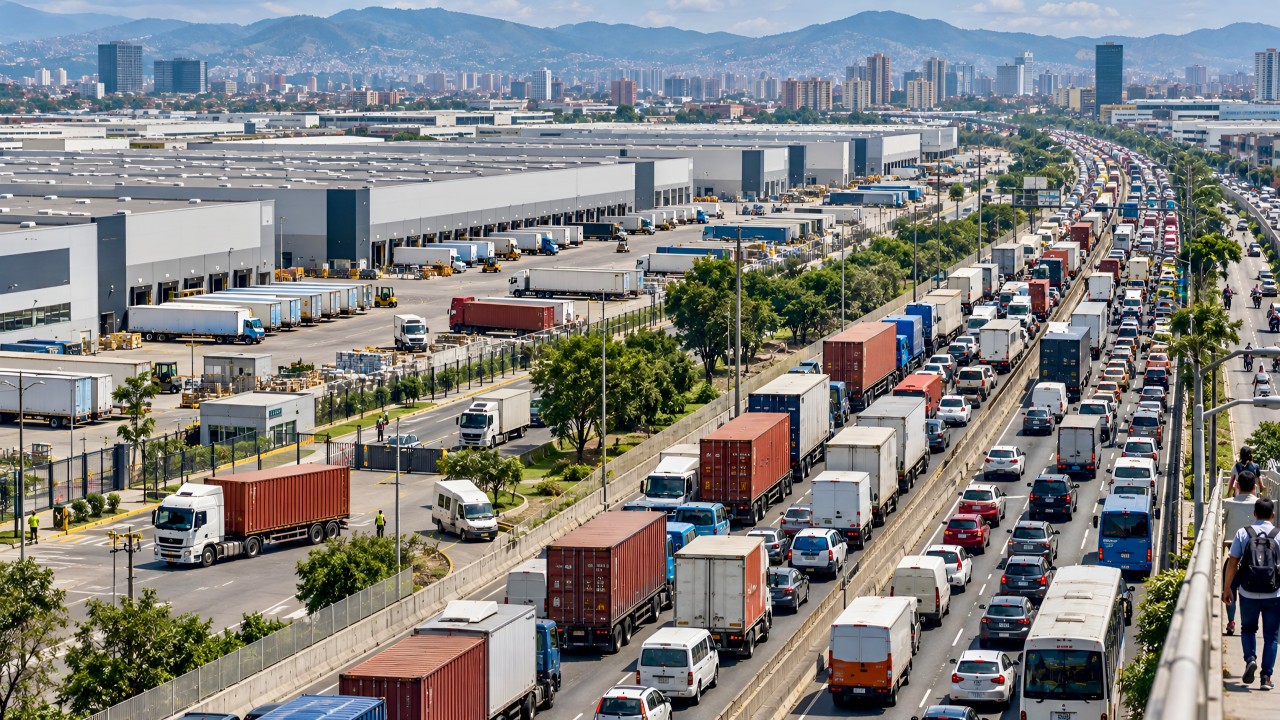
Trucks delivering in the middle of the road. Sidewalks turned into loading zones. Streets functioning as operational yards. Housing, retail, and logistics coexisting without ever having been designed to.
This isn't the exception. It's the routine.
And that raises a question we can no longer keep avoiding:
When did we decide the city could become everyone's logistics infrastructure?
Urban logistics stopped being invisible
Today it occupies the street
For years, urban distribution was a quiet process. Today it's visible, constant, and everywhere.
Neighborhood retail, hard discount, food, beverages, pharmacies, digital platforms: all of them operate on the same physical base — the city — with no shared logic for how to use its space.
Urban logistics stopped being just the movement of goods. It became a systematic occupation of public space.
And that has consequences.
The structural error: operational efficiency without an urban reading
Companies measure with precision:
logistics costs
restocking frequency
delivery times
service levels
But they don't measure:
how much urban space they consume to operate
how much friction they generate on the street
how many conflicts of use they trigger
how much social tolerance they wear down
The equation is incomplete once again.
Efficiency gets optimized inside the company. The cost gets absorbed outside, in the city.
When that cost isn't measured, it gets normalized. And once it's normalized, it multiplies.
The city as unplanned infrastructure
The picture is clear: the roadway functions as a loading zone, the sidewalk as an extension of the warehouse, the neighborhood as a logistics platform.
But the city wasn't designed for that.
It doesn't have:
enough loading areas
coordinated schedules
nearby consolidation nodes
real integration between uses
What looks like it's "working" today is working at the expense of public space.
The city became logistics infrastructure without ever having been designed as such.
eCommerce didn't create the problem — it accelerated it
This needs to be said clearly.
eCommerce isn't solely responsible. But it is the great accelerator.
What used to happen at certain hours now happens all day long. What used to be occasional restocking is now a constant flow.
eCommerce didn't invent the occupation of the street. It intensified it, made it permanent, and pushed it to the limit.
That's why the problem is no longer sector-specific. It's systemic.
When the city starts to push back
Cities don't react out of ideology. They react out of saturation.
First come the neighbors' complaints. Then the time-window restrictions. Then the bans, the regulatory patches, and the reactive decisions.
Not because they're against logistics. But because they can no longer function as free-of-charge support for a model that doesn't internalize its own impact.
Here's the point many still underestimate:
The main risk to urban logistics is no longer operational. It's urban, social, and regulatory.
And once that comes into play, efficiency stops being an advantage.
More fleet and more technology don't fix the misuse of the city
Optimizing routes doesn't fix the lack of space. Digitizing deliveries doesn't create loading zones. Speeding up flows doesn't reduce urban conflict.
Logistics has been brilliant at optimizing its own internal system. It has been weak at understanding the urban system it depends on.
The city isn't an infinite resource. It has physical, social, and political limits.
Continuing to scale without redesigning the relationship with urban space isn't progress. It's shifting the problem onto the surrounding environment.
The real competitive advantage: operating without breaking the city
The urban logistics of the future won't be defined by speed or cost alone. It will be defined by its capacity to coexist.
The real competitive advantage will be this:
Supplying the city without turning it into a permanent operational yard.
That requires:
joint urban-logistics planning
well-located consolidation nodes
real proximity
integration with mobility and land use
This isn't a "green" agenda. It's an agenda of urban viability.
Remember this
Urban logistics isn't failing. It's working too well within a model the city can no longer absorb.
As long as we keep calling it efficiency when a system needs to occupy the street just to operate, the conflict will keep escalating.
The question is no longer how to move more goods. It's how to do it without turning the city into improvised infrastructure.
And that question — today — still has no clear answer.