Throughout my business career there was a phrase that seemed to settle almost any real estate conversation:
“Location, location, location.”
I repeated it many times myself. And I still believe in it.
A good location can completely change the outcome of an investment. What I have begun to question over the years is not its importance, but something different:
Do we still correctly understand what it means to be well located?
It used to seem simpler. There were a few variables that almost always came up first:
- Good access.
- Visibility.
- Traffic.
- Zoning.
- Proximity to centers of activity.
- Price per square meter.
All of that still matters.
But cities have changed. So have the ways we work, shop, move around, live and use our time.
And that ended up changing my own way of evaluating a location.
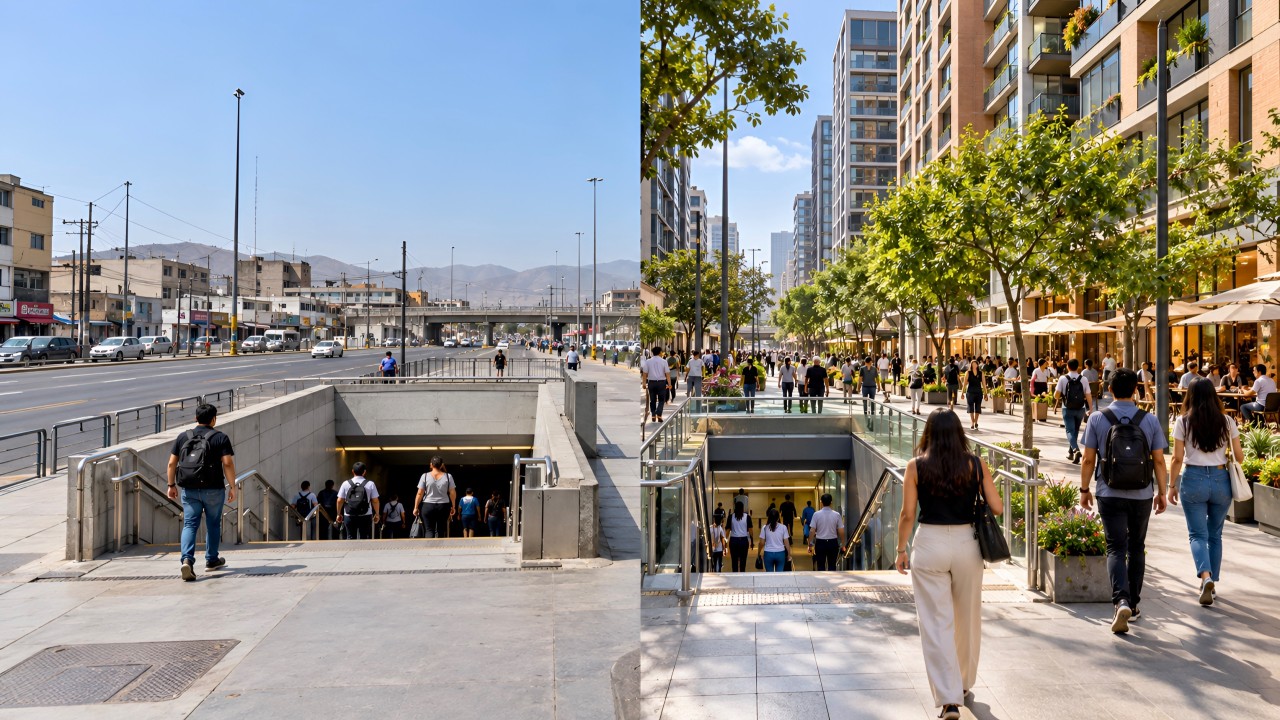
Two places can be very close and work in completely different ways
Let us imagine two plots of land a few blocks apart.
They are in the same district, have access to a major avenue, similar prices and even similar zoning parameters.
On paper they might seem practically equivalent.
But from one, a person can walk to public transport, buy everyday goods, find a café, reach services or take care of several activities without long trips.
From the other, almost anything may require a car, more time and longer distances.
Geographically they may be very close. Functionally they may be very far apart.
Over the years I have learned to pay much more attention to that difference.
Because an address tells us where a property is, but not necessarily how well that place works for those who will live, work, shop or do business there.
And that is where a first answer to the question in the title begins to appear.
Perhaps we can no longer evaluate a location by asking only where something is.
We also need to understand what it allows us to do from there.
There is a value that almost never appears in a land listing
When we analyze a real estate investment we constantly talk about square meters.
Price per square meter, buildable area, sellable area, rents, absorption.
But there is another variable that we rarely include with the same weight:
People’s time.
- How long does it take someone to get to work?
- How many trips do they need to take care of everyday life?
- Can they combine several activities in a single outing?
- How much time do they end up losing simply because housing, work, retail and services are too far apart?
None of this normally appears in a property registry record.
Yet it can greatly influence the decision to live, work, shop or invest in a particular place.
That is why today I think a good location does not only bring destinations closer.
It also reduces friction.
And when a place allows people to do more things in less time, it begins to generate a value that we may not yet be measuring enough.
An excellent location today may not be one tomorrow
This is probably one of the lessons that has changed my way of investing the most.
I have seen areas that were extraordinary for a given activity and, over the years, began to lose part of what made them attractive.
The address did not change.
Everything else did:
- Consumption habits.
- Mobility.
- Families.
- Companies.
- Technology.
- Commerce.
- The city’s own rules.
Then I understood that a location does not only have a position.
It also has a trajectory.
And that is when I started asking myself questions that did not always come up so early before.
- What infrastructure is arriving?
- What activities are beginning to appear?
- Which ones are starting to disappear?
- How is the population that lives or works there changing?
- Can that environment adapt if needs are different tomorrow?
Today that capacity to adapt is part of how I read a property.
Because I am no longer interested only in knowing how a place works now. I also try to understand how likely it is to keep working well when its surroundings change.
That is why today I look at a location from three dimensions
Over time I simplified my own way of evaluating it.
Today I try to answer three questions:
- Physical location: where is it and how is it really connected?
- Functional location: what can a person get done from there?
- Temporal location: how likely is it to remain relevant when the city and its needs change?
The first is the one we have traditionally observed most closely.
The second forces us to look at everyday life.
The third forces us to lift our eyes beyond the present.
An excellent physical location may work poorly in daily life. And both can lose value if the surroundings are unable to evolve.
That is why it is no longer enough for me to know that a property is near an avenue, a transport station or a well-known area.
I want to understand how all those pieces work together and where they seem to be heading.
Even the word “prime” is starting to seem more complex to me
For a long time we associated a prime location with certain streets, districts or postal codes.
Many of those places will surely remain extraordinary.
But I am increasingly less interested in the label and more in how a place functions.
A very established area may begin to suffer greater congestion, longer commutes or a loss of diversity of activities.
Meanwhile, another that is still little observed may begin to add transport, services, infrastructure and new urban rules that completely transform how it works.
So the question stops being only:
What is the best address today?
And becomes another:
Which place is building better conditions to remain valuable tomorrow?
For someone who invests looking several years ahead, the difference between the two questions can be enormous.
So, is “location, location, location” no longer enough?
After so many years, my answer would be this:
The phrase is still completely valid. What is no longer enough is to keep understanding “location” the way we used to.
Today I no longer see it only as a point on a map.
I see it as a combination of connectivity, possibilities and capacity to adapt.
Where it is.
What it allows you to do.
And how likely it is to remain useful when its surroundings change.
If I had to sum up in a single idea what I have learned about location, it would be this:
It is not enough to know where an asset is. We must understand what it allows people to do from there and what possibilities it will have when the city changes.
That also changed the questions with which I begin to evaluate an investment.
Before, it might have been enough to ask myself:
Is it well located?
Today I need to go a little further:
Does this place allow people to live, work or do business better than other similar places, and does it have the conditions to keep doing so ten years from now?
Because the value of a square meter does not end at its four sides.
It also depends on everything a person can do around it and on how that environment may evolve.
Perhaps that is the true update to the phrase we repeated for decades:
“Location, location, location” still matters. What has changed is everything we should be able to see today when we talk about location.
And if you were to evaluate again what you consider the best location in your city, would you still choose it for the same reasons as ten years ago?