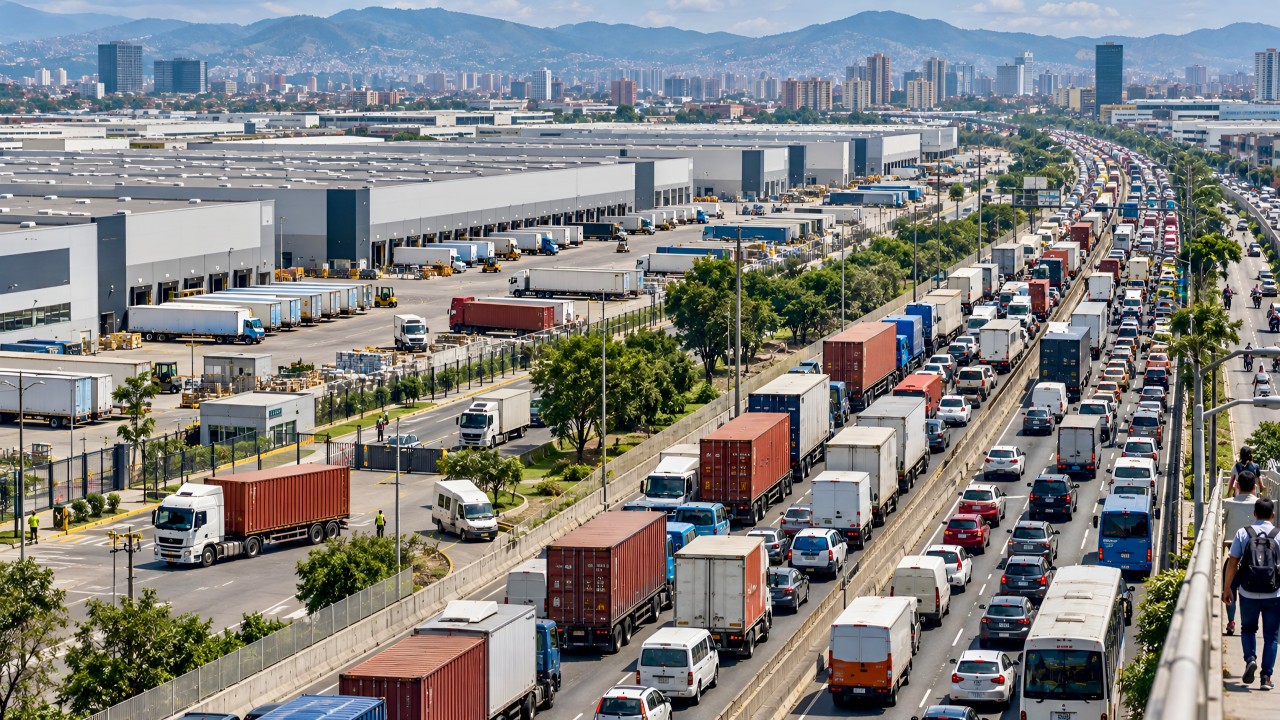
For years we've thought of urban logistics as an operational problem. Something to be "solved" so it doesn't affect the city too much.
That's where the mistake lies.
When a city sees logistics as a problem, it pushes it out onto the street with no order, no clear rules, and no integration. The result is easy to recognize: vans double-parked, constant noise, sidewalks taken over, wasted time, and a permanent sense of disorder.
It isn't a logistics problem. It's an urban problem.
And as long as we don't understand it that way, we'll keep repeating the same pattern.
What starts to stand out when you look at other cities
When you observe how other cities work, the difference shows up fast.
You don't see trucks everywhere. You don't see couriers racing against the clock. You don't see the street turned into an improvised loading zone.
What you see is something else: infrastructure designed as a system, clear flows, points of proximity, and a logistics operation that knows where it should be — and, above all, where it shouldn't.
The goods still arrive. But they no longer compete with everyday life.
A city that feels different
And then something interesting happens.
The streets feel different. Not faster. Calmer.
Walking stops being an exercise in dodging obstacles. Public transport stops competing for space. The neighborhood regains a certain normalcy you didn't even realize you'd lost.
It isn't a dramatic change. It's a quiet one. But you feel it every day.
Time as an indicator of urban quality
One of the great costs of urban chaos is time.
Time trapped in traffic. Time spent waiting for a delivery that never comes. Time spent bending your life around a city that won't cooperate.
When logistics gets integrated into the urban system — when it moves closer, gets organized, and becomes predictable — that time comes back. And when time comes back, the city becomes more livable.
Not because it's more efficient, but because it stops wearing people down.
Not just better delivery — better coexistence
The point isn't how goods get delivered. The point is how the city decides to coexist with what it consumes.
This isn't about copying models or importing solutions. It's about a deeper decision: to stop treating logistics as something foreign to the city and start thinking of it as part of its everyday functioning.
The cities that understood this didn't build more infrastructure. They asked better questions.
Where should goods be. When should they move. At what scale. With what impact.
And, above all, how do they coexist with people.
The question that remains
When a city stops fighting with its own logistics, it doesn't just improve traffic. It improves what it feels like to live there.
The question isn't whether our cities can do it. The question is whether we're willing to stop normalizing chaos and start designing the city as a system built for people.