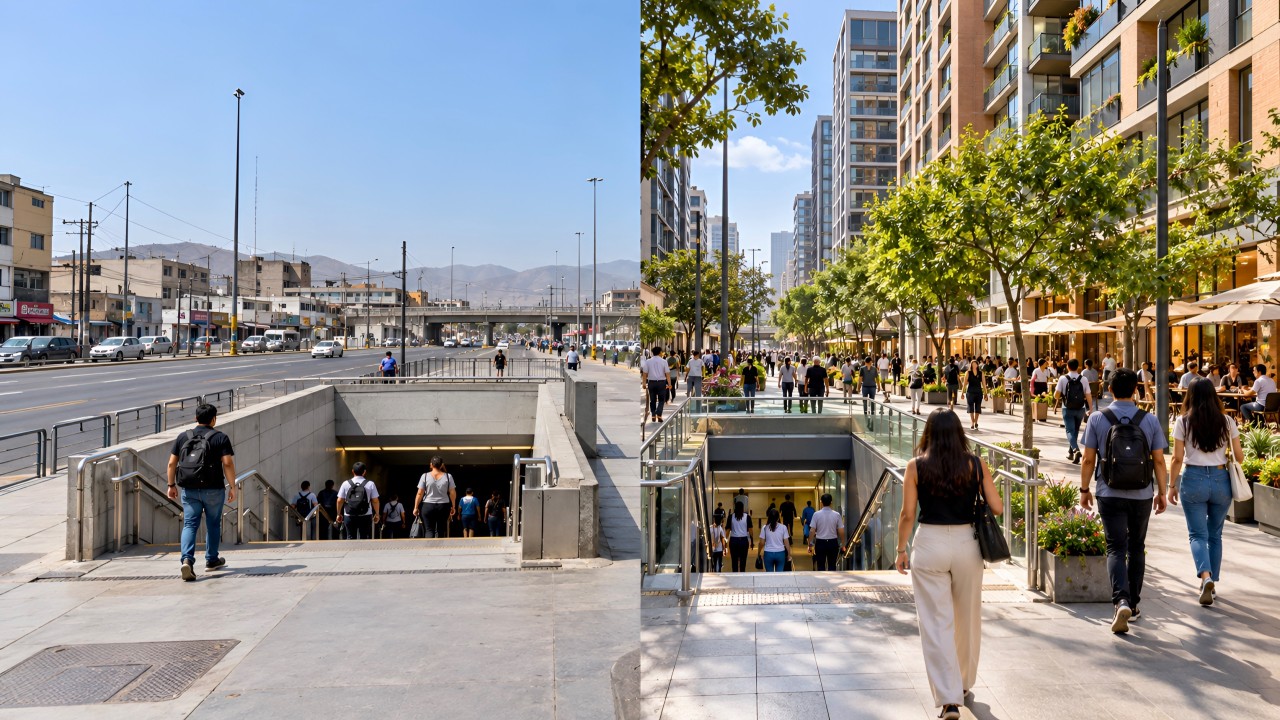
I had walked through that area many times and, at first glance, it still looked the same.
The same plots of land, the same streets, the same businesses as always.
Until one day something stopped fitting.
A shop had changed its activity. A plot I remembered as practically motionless was starting to show movement. More people were coming and going, and some businesses were beginning to extend their hours.
None of these things, taken separately, meant very much.
But together they were starting to tell me something.
The area had not started changing that day. I had started noticing that day.
Sometimes we keep looking at an area as it used to be
For years we can get used to defining a place by what it has always been: industrial, residential, commercial, peripheral or simply a place to pass through.
And that definition ends up conditioning the way we see it.
For a long time we looked at certain plots of land simply as industrial, while around them housing, new services, other forms of mobility and people with different needs were beginning to arrive.
The land could remain exactly the same.
The city around it no longer did.
That was when I began asking myself a different question.
Not only what had arrived.
But what was starting to stop being the same.
Because important transformations do not always begin with a major construction project, a new station, a shopping center or a regulatory change.
Many times they begin much earlier and in a far less obvious way.
A business changes its activity.
A shop starts closing later.
A property that had been idle for years has movement again.
People who did not used to frequent the area begin to arrive.
And something that used to be enough starts falling short.
Then you begin to look differently.
More housing, but few services.
More workers, but little food on offer.
More commercial activity, but no suitable space for loading and unloading.
More people walking, but few places to stop.
And you understand that what begins to be missing may also be telling you something about what has already changed.
The street does not give me the answer. it gives me better questions.
Then I began to pay more attention to the people who live and work there every day.
Someone who runs a shop may notice that different customers are arriving now.
A delivery courier may realize they are receiving more orders.
Someone who has been in the area for years may sum it up in something as simple as:
“This wasn’t like this before.”
None of that replaces data.
But it can point you to where to start investigating.
And I think that difference matters.
Observing an area does not mean deciding by intuition.
It means detecting something that deserves to be verified.
So I go back to the information: mobility, demographics, prices, transactions, uses, regulations, infrastructure and public or private projects.
And I try to answer five questions:
- What is happening today that did not happen before?
- Who is arriving and why?
- Which use is starting to change?
- What is beginning to be missing?
- Does the data confirm what I am seeing and hearing?
Sometimes it does.
Other times it does not.
Both answers are useful.
Because reading an area is not about looking for arguments to prove that our first impression was right.
It is about understanding whether reality is truly changing.
And here a lesson appears that has become more and more important to me over the years:
we should not evaluate an area only by what it is today, but also by what it is beginning to stop being.
Perhaps that is why we often return to a place we thought we knew and suddenly find new projects, more commerce, more housing or more movement.
And then that question appears:
what happened here that I did not see coming?
It probably did not happen overnight.
The signs were already there.
It is just that we kept looking at the city as it used to be.
The area looked the same.
But it had not been the same for a long time.
In which area has it happened to you that, by the time you finally noticed the change, it was already obvious to everyone?