If you're evaluating projects only by asset class — residential, commercial, or logistics —…
you're making decisions on incomplete information.
And the most worrying part is that this isn't a technical error.
It's a reading error.
Because the city has already changed. But a lot of decisions — about investment, location, product — still start from a logic that no longer creates value.
The model that worked… is starting to fail
For years, real estate development relied on a clear classification:
residential, commercial, industrial.
Each asset had its space.
Each use its own logic.
Each market its own dynamics.
That model allowed growth.
But today it's starting to show its limits, and not in theory — operationally.
And here's where the first uncomfortable point shows up:
the problem isn't the market.
the problem is that we're making decisions under a logic that no longer captures value.
This is already showing up in:
projects that depend too heavily on their surroundings
areas that only come alive at certain hours
assets that lose efficiency over time
And all of this shares a common root:
we keep separating functions in a city that no longer functions separately.
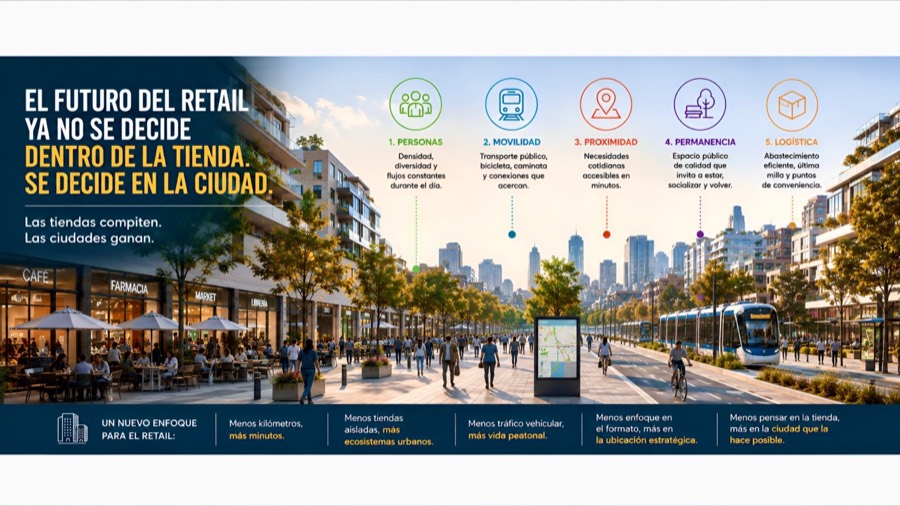
The city no longer works by use. It works by overlap
If you look at where real urban activity is concentrating today, the pattern is obvious:
everything happens at once.
At the same point you'll find:
People who live there
People who work there
People who shop there
Systems that distribute goods
Infrastructure that connects it all
This isn't a trend.
It's the current condition of the city.
And here's where the second critical point appears:
you can no longer clearly tell where one use ends and another begins.
And if you can't tell them apart in the city…
you shouldn't keep separating them in development either.
Even when the city looks integrated… it doesn't work as a system
This is where theory breaks against reality.
Because you can have everything an environment needs to function… and it still doesn't function.
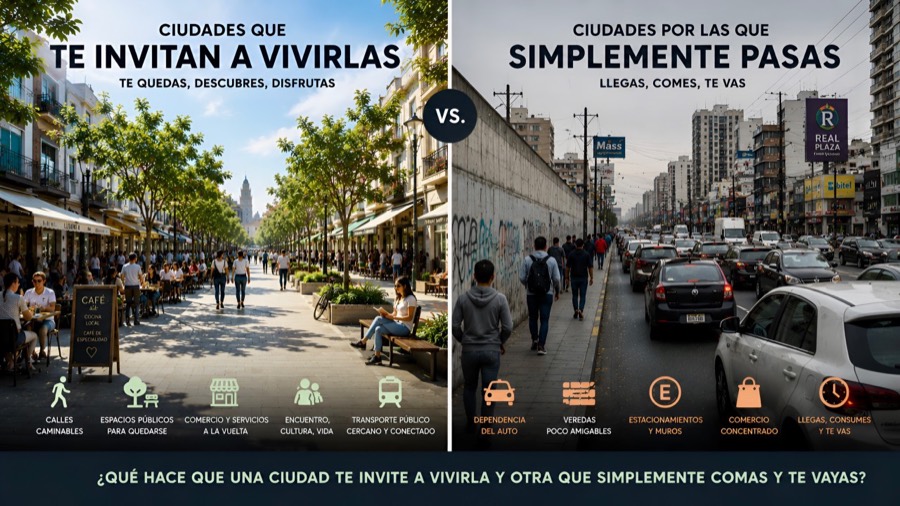
Residential projects on well-connected major avenues. Shopping centers a few meters away. Amenities nearby.
On paper, everything looks solved.
But when you get down to the street…
you can't cross it.
There are no traffic lights.
There are no continuous sidewalks.
There are no real pedestrian crossings.
And then the contradiction appears:
the city is connected… but it isn't walkable
the uses are close together… but they aren't integrated
And that's where everything breaks down.
Because the city doesn't fail for lack of components.
It fails because those components don't talk to each other.
Value is no longer in the use. It's in the integration
This is where the impact stops being conceptual and becomes economic.
The market keeps designing projects as if those dynamics could be separated.
As if it were still viable to develop "pure" assets in areas where the city is already fully hybrid.
The result isn't always immediate.
But it ends up showing up.
And when it does, it shows up as:
slower absorption
more pricing pressure
excessive dependence on context
less ability to differentiate
And here's the question few people ask in time:
Is the problem the product… or the logic it was conceived under?
Value is no longer in the use. It's in the integration
This is the shift that redefines everything.
Value is no longer explained by what the project is.
It's explained by how it integrates with what happens around it.
Projects that manage to integrate multiple dynamics:
capture more demand
generate more dwell time
activate their surroundings better
and adapt more easily to market shifts
Not because they're bigger.
Because they're better read.
And here's a key difference:
some are developing products.
others are starting to build systems.
The unit of analysis has changed (and this redefines where to invest)
If you're still analyzing the city by district…
you're already behind.
Value today is concentrating at specific points where these converge:
connectivity
constant flow
economic activity
real, sustained presence of people
Those points don't answer to a zoning map.
They answer to their capacity to sustain multiple dynamics at once.
And that's where one of the market's biggest opportunities is emerging… and also one of its biggest reading errors.
The market keeps competing on products… when it should be competing on systems
This is, probably, the biggest disconnect today.
The market keeps evaluating:
asset types
square footage
programs
But the city no longer rewards that on its own.
Today, what really competes is a project's ability to integrate into a broader urban system.
A single-use project:
depends on its surroundings
generates more trips
loses efficiency over time
limits its ability to adapt
A project that understands hybrid logic:
integrates multiple sources of value
reduces friction between activities
increases dwell time
improves its resilience
The difference isn't in the final design.
It's in how the city is understood before designing.
Conclusion
The city isn't becoming hybrid.
It already is.
The difference is that some have already started making decisions under that logic… and others are still developing as if the city worked in separate pieces.
And here's the most uncomfortable point of all:
the market isn't going to tell you when you've arrived too late.
By the time this is obvious to everyone…
it will no longer be an opportunity.
So the question stops being an urban one.
It becomes strategic.
Are you developing a product… or building a system capable of capturing value in a city that has already changed?
Because in the scenario ahead…
it won't be won by whoever builds the most.
it will be won by whoever understands first.