There's something that catches my attention more and more when I observe how we live and move through a city.
A person leaves home.
Walks a few blocks.
Takes a bus, the metro, a bike, or drives.
Buys a coffee.
Arrives at work.
Receives a package during the day.
On the way back, stops by a store, a supermarket or a pharmacy.
And finally returns home.
It looks like just an ordinary day.
But behind that journey, many of the activities that make a city work are happening at the same time:
Housing.
Mobility.
Retail.
Logistics.
Services.
So a question comes to mind:
At what point did that person stop being just one person?
To the real estate developer, she's a resident.
To the retailer, a consumer.
To transit, a passenger.
To logistics, a delivery point.
But to the city, she was always the same person.
Maybe we were the ones who split her up.
We've learned to understand our sectors. But not always the city that connects them.
In housing, we analyze demand, prices, density and land availability.
In retail, we study foot traffic, catchment areas, spending and competition.
In logistics, we analyze warehouses, inventory, routes, time and cost.
All of that is necessary.
But when every decision is made in isolation, we can end up optimizing each part while making the whole less efficient.
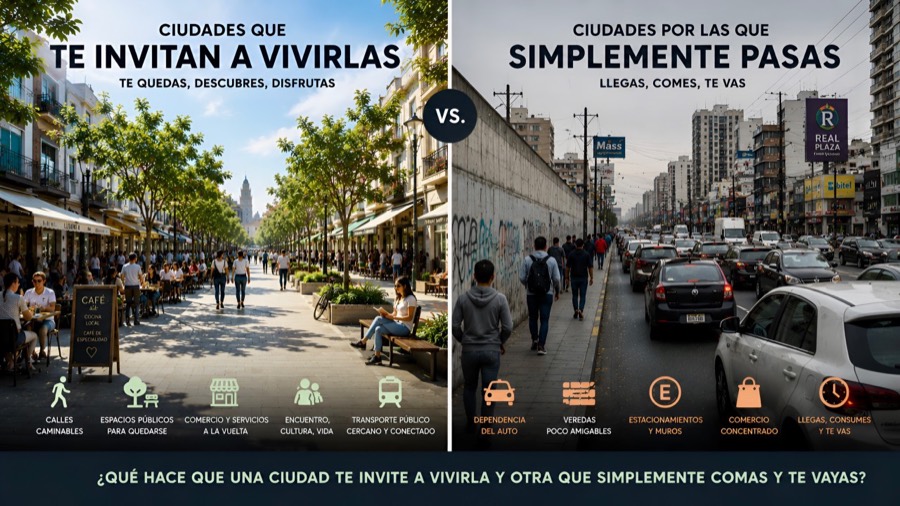
Housing far from jobs and services.
Stores disconnected from everyday routes.
Large warehouses we have to cross half the city from just to reach the customer.
Individually, each decision can look correct.
The problem appears when we put them all together on the same city.
Maybe we should start by watching people
Before asking where to build, where to open a store, or where to locate a logistics operation, maybe we should answer five much simpler questions:
Where do people live and where do they work?
How do they move between the two?
Where do they shop and use services?
Where do those journeys concentrate?
What needs are still unresolved?
When we start observing a city this way, trips stop being just trips.
They become information.
Thousands of people repeating the same routes every day are telling us something.
A station that starts concentrating more and more people is telling us something.
A neighborhood whose residents have to travel long distances to work, shop or access services is telling us something too.
And an area where transit, housing, retail and services start to converge is probably showing us something even more interesting:
a new centrality may be starting to emerge.
And that's where the three industries start to meet
For housing, it shouldn't matter only where the land is.
It should also matter what city exists from the building's front door outward.
For retail, it may no longer be enough to know where the consumer is.
We need to understand the path their life takes.
And for logistics, it may not be enough either to keep asking how to make the last mile more efficient.
We should also ask ourselves:
where are we actually supplying the city from?
Because it's contradictory to want:
faster and faster deliveries;
lower costs;
fewer kilometers traveled;
fewer emissions;
While we keep supplying much of that demand from places farther and farther from where people actually live.
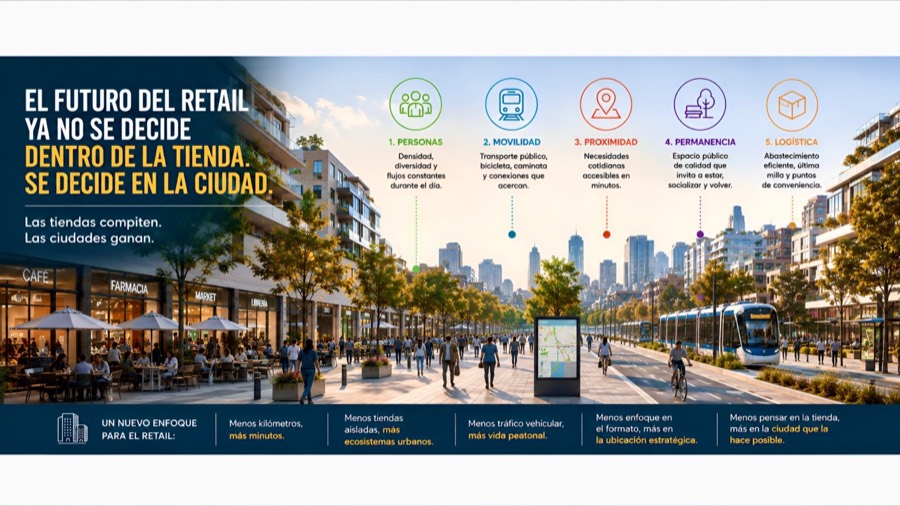
Maybe that's why concepts like urban centralities, proximity retail, micro-hubs, pickup points and more decentralized logistics networks are starting to make a lot more sense.
Not only from a logistics standpoint.
From the city's standpoint.
One decision feeds the next
A transit infrastructure project can change the routes of thousands of people.
Those routes can generate new centralities.
Centralities can attract housing.
Housing generates demand for retail and services.
Retail needs supply.
And logistics needs to move closer to that demand.
Everything ends up meeting in the same place.
The city.
That's why it's getting harder and harder for me to talk about housing without talking about mobility.
About retail without talking about urban planning.
Or about logistics without talking about where people live and how they move.
Maybe the next competitive advantage won't lie only inside our own industries.
Maybe it lies in our ability to see, before others do:
where people are starting to live;
how their routes are starting to change;
where they're starting to concentrate;
what they want to solve close to home;
and what new centralities are starting to emerge.
Because if we're able to understand those shifts, maybe we can also anticipate where it will make sense to develop housing, where new demand for retail will appear, and how the logistics that supply those places should be organized.
That's why I believe the future of logistics, retail and housing starts with understanding how a city works.
And understanding a city starts with understanding the people who live in it.
The question I'd leave on the table is this:
Are we designing our projects around our business models, or around the way people actually live and move?