
For many years I thought real estate development began with finding a good site.
Like most people, I looked at location, access, zoning, demand and development potential.
I believed that's where the great opportunities began.
Over time I discovered I was asking the wrong question.
Because a site's real value is rarely born within its own boundaries.
It's born in the city around it.
That was probably the most important lesson from years of walking cities.
I wasn't traveling in search of buildings.
I was traveling trying to answer a question that still guides every project I analyze today.
Why do some places become a city's most valuable ones, while others, with seemingly similar conditions, never manage to?
With every city I toured, I found the same pattern.
Great urban transformations never began with a building.
They began much earlier.
An infrastructure decision.
A new form of mobility.
A new vision for the city.
New rules for growth.
The buildings came later.
The market came later.
And, almost always, most of the value appreciation arrived later too.
That's when I understood something that completely changed how I analyze an opportunity.
The real estate market's biggest mistake isn't picking the wrong site.
It's arriving too late.
From that point on, I stopped starting my analysis with the site.
I started with the city.
The decisions it was making.
The infrastructure that would start reshaping mobility.
Regulatory changes.
The places where all those factors were beginning to line up.
And it was precisely that new way of looking at the city that led me back to a place I'd known for years.
A place where we had developed an asset that had served its purpose perfectly.
I knew it so well I could practically walk it from memory.
And yet I clearly remember one visit after coming back from one of my trips.
I had been there hundreds of times.
But that day was different.
Not because the site had changed.
It was still exactly the same.
What changed was how I looked at everything happening around it.
For the first time, I stopped looking only at its boundaries.
I started looking at the city.
And I understood something that still guides every decision I make.
The site hadn't changed.
I had.
Because I no longer saw just an asset.
I saw:
Infrastructure.
Mobility.
Connectivity.
Urban transformation.
A city beginning to grow in a different way.
And I understood that when all those pieces start coming together in one place, the real value isn't reflected in the land price yet.
It's in the direction the city is heading.
That's the thinking that gave rise to El Mirador.
It wasn't born because I wanted to develop a mixed-use project.
It was born because I understood that place could no longer respond only to the Lima we knew.
It had to respond to the Lima that was beginning to be built.
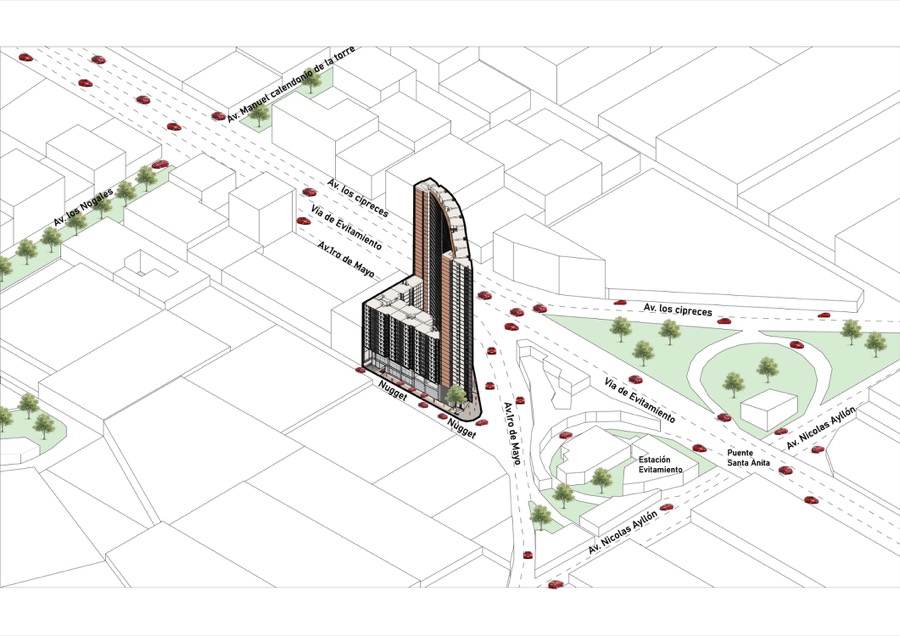
I'm not sharing this image to show a building.
I'm sharing it because it represents a conviction that completely changed how I understand real estate development.
Great projects don't create great cities.
Far more often, it happens the other way around.
It's cities that create the conditions for great projects to emerge.
Maybe that's why today I spend far more time studying cities than looking for sites.
Because sites change very little.
Cities change every day.
And those who learn to read those changes before the market does tend to discover opportunities that, once they finally become obvious to everyone, can never be repeated.
That's why I still believe the most important question isn't:
Where should the next project be built?
The truly important question is a different one.


