More than an entrepreneur: someone who never stopped building

- Years of experience
- 30+
- Different industries
- 8
- Cities researched
- 10+
- LinkedIn Top Voice
- 2022
Before being a speaker or a mentor, I am simply someone who never stopped building. Over more than 30 years I moved through industries that, at first glance, have nothing to do with one another: agriculture, baking, construction, textiles, metalworking, metal structures, logistics, and mixed-use projects. Today I'm a director of several of those companies, including VallejoGroup.
It wasn't a master plan. It was curiosity: every time I understood one business, I wanted to understand the next. That same curiosity is what, after the pandemic, led me to look beyond my own companies — to walk cities, ask questions, and, almost without planning it, end up giving talks about what I was learning.
Eight industries, one way of seeing
- Agribusiness
- Baking
- Construction
- Textiles
- Metalworking
- Steel structures
- Logistics
- Mixed-use projects
Starting out without the family name
I come from a family of entrepreneurs. My father, engineer José Vallejo, spent more than four decades building businesses in Peru and became a respected figure in the business world. I wasn't content to simply take the reins of the family businesses: I decided not to work in them and, at 18, started building my own path from scratch, because one thing was very clear to me — I wanted to be known for my own achievements and my own mistakes. That's how I began earning a name of my own — with my own goals and, above all, my own falls.
From my father I inherited a taste for business, and I learned a phrase I never forgot: "the person who stays active, lives". Over the years I understood that phrase wasn't just about work: it was about never standing still, never settling. Maybe that's why I never stopped moving between industries.

I lost a lot of things. I never lost the drive.
Earning a name of my own wasn't a straight line. Along the way I took on businesses that didn't go well, and I over-leveraged myself more than once chasing opportunities that, looking back, I know weren't ready — or that I wasn't ready for. There were real losses, the kind you feel in your pocket and in your pride.
But it was never failure that defined those years — it was what I did after each one. I learned to look at mistakes, mine and other people's, not as the end of something but as information: what to avoid next time, what signal I ignored, what decision to make differently. That habit of learning from falls is today one of the tools I use most when advising other entrepreneurs.
"One door closes, ten windows open. It's not just a nice saying — it's literally how I've built every one of the industries where I have a presence today."
From my office to airports
For more than three decades, most of my professional life unfolded among companies, projects, and offices: creating, investing, managing, directing, chairing my own companies. It was the world I knew, and the one where I had built practically my entire professional career.
But after the pandemic something happened that wasn't in my plans: I began traveling differently. No longer only for business. I started touring cities to observe them, understand them, and learn from them — attending trade fairs, congresses, and forums, listening to architects, urban planners, developers, retailers, logistics operators, entrepreneurs, and professionals who were trying to answer many of the same questions I was starting to ask myself.
And, almost without planning it, I also started giving conferences and talks. Suddenly my office began to feel a little farther away. And airports, much closer.
Madrid, Barcelona, Paris, Valencia, Seville, Rome, Venice, Santiago, London, Copenhagen, Lisbon, and other cities gradually became places to observe, walk, converse, test ideas, and keep learning.
At first I spoke mainly about sustainable last-mile logistics. Then came sustainable mobility, neighborhood retail, 15-minute cities, and mixed-use projects connected to mass public transit like the metro. Until I understood that, in reality, I had for some time been talking about something much bigger: the city itself.
After so many years doing something, you might think your roadmap is already written. Not necessarily: you can turn the wheel, you can start over in something that was never part of your plans, you can go from teaching what you know to discovering how much you still have left to learn.
I'm still an entrepreneur. I keep investing, creating, and developing projects in the industries that shaped me. But now I also walk cities, listen, research, write, share, and learn. Sometimes all it takes is daring to take that step.

From theory to practice, with people along the way
What I share in talks, mentoring sessions, and consulting doesn't come from a book: it comes from having made real decisions in real industries, from having walked cities and factories, and from talking with the people who make them run every day.
I bring that same closeness to every mentoring or consulting session — more honest conversation than corporate speech.
"After so many years doing something, you might think your roadmap is already written. Not necessarily: you can turn the wheel."
I'm not looking to retire. I'm looking for the next challenge.
I've never been interested in the idea of working hard just to one day stop. I enjoy exactly what I do: building companies, traveling, discovering new cities, doing sports, starting over. When something stops challenging me, I take it as a sign — not that I need to rest, but that I need a bigger challenge.
That same restlessness is what took me from running factories to studying cities, and it's what still puts me on a different plane every month. I don't have a retirement plan. What I do have is an ever-growing list of things I still want to build — and the habit of studying other people's successes and mistakes so I don't have to make them myself.
Urban research, applied to real projects
In recent years, part of my work has evolved toward a broader mission: understanding how the world's most successful cities evolve and identifying the principles that help build more competitive, livable, and sustainable neighborhoods. Through field research and direct observation in Europe and Latin America, I analyze how urban development, mobility, retail, mixed-use projects, and urban logistics converge to shape the next generation of cities.
This vision is being put into practice through the development of an ambitious mixed-use urban project in Lima, designed around a metro station. I firmly believe that the future of cities will not be defined solely by iconic buildings or technological innovation, but by better neighborhoods: neighborhoods where housing, retail, mobility, public space, services, and logistics function as a single ecosystem.
My purpose is simple: to help rethink how cities are designed, developed, and lived in, sharing knowledge that inspires better urban decisions for future generations.
A journey across the Americas and Europe
From Lima, urban research has taken me to walk and study cities across three continents.
A track record backed by results
-
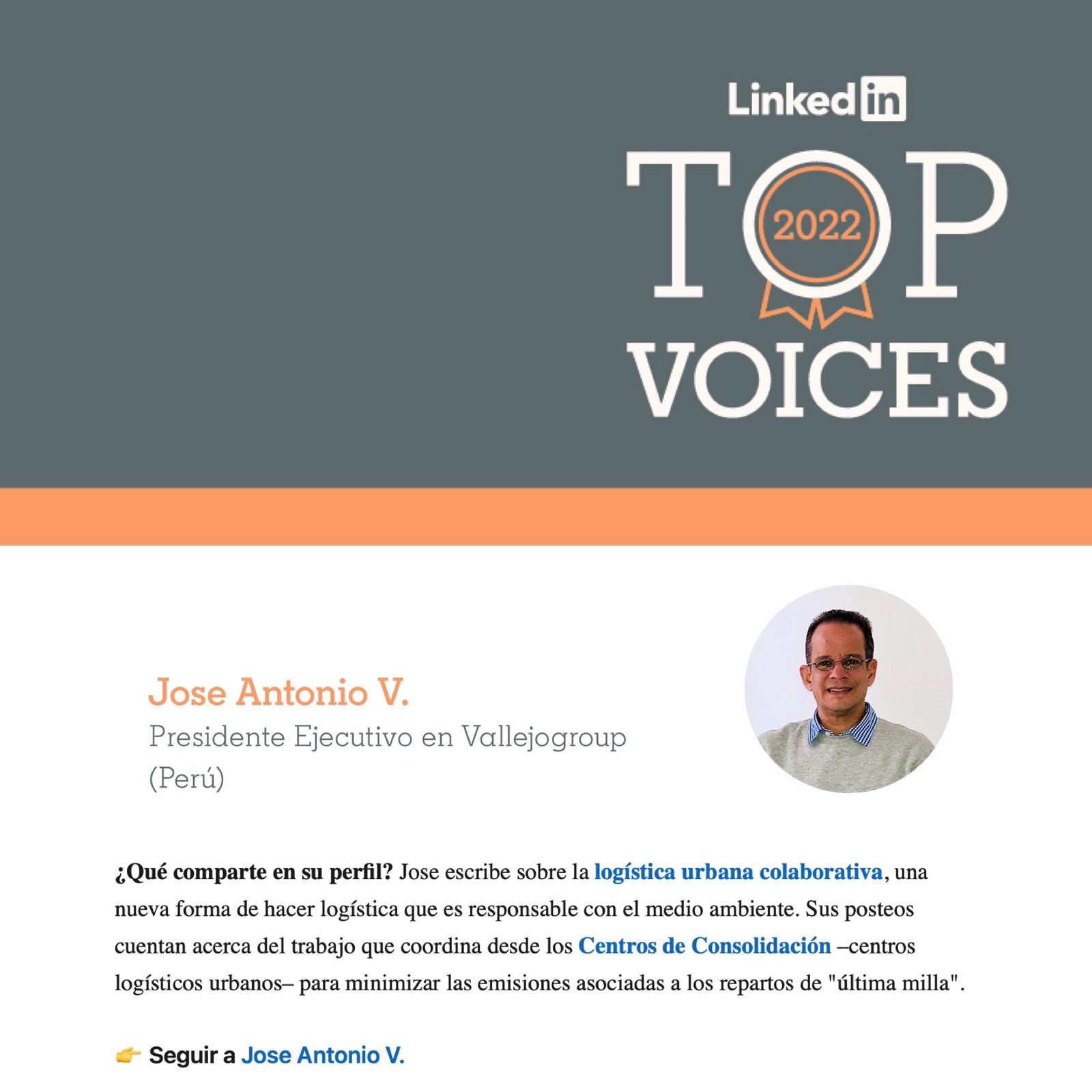
LinkedIn Top Voice 2022
Recognized by LinkedIn among Peru's most prominent voices for his posts on collaborative urban logistics.
-
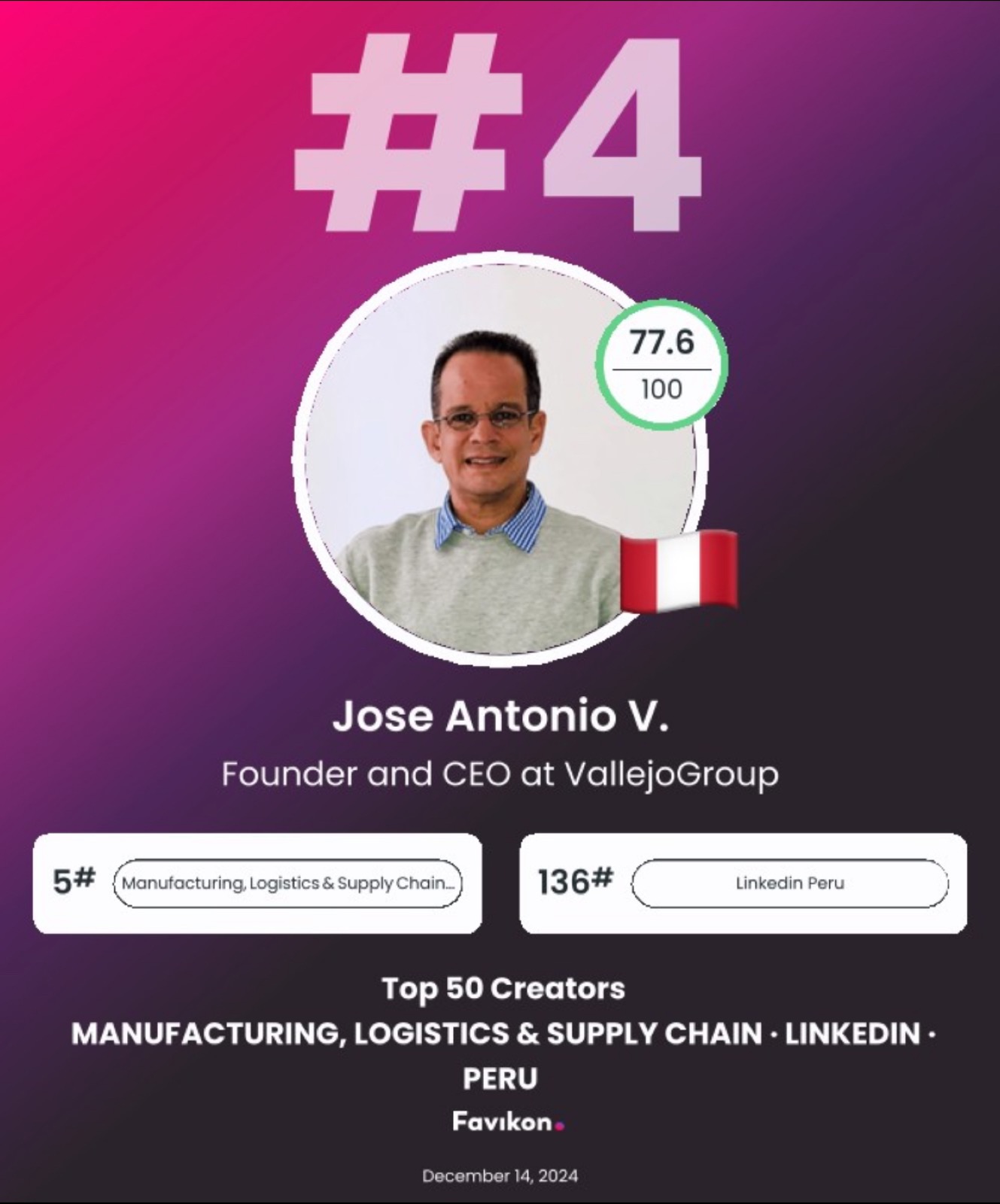
LinkedIn Top 50 Creators
No. 4 in Manufacturing, Logistics & Supply Chain — LinkedIn Peru (Favikon, Dec. 2024).
-
Certified Mentor
Business Mentor certification awarded by the Fundación para el Conocimiento madri+d (Madrid). Certificate No. 38-014/22, valid through 2027.
-
Director across multiple industries
Over 30 years as director and founder of companies in agriculture, baking, construction, textiles, metalworking, structures, and logistics — including VallejoGroup.


Let's work together
Mentoring, consulting, or a keynote for your next event.
I reply within 48 hours.